
On Interpretation
The limits of my language mean the limits of my world


Law does not exist independently of language: it is scaffolded by it and constituted by it. Concepts such as consent, culpability and contract are constructed through language. Legal outcomes hinge upon who said what; statutes, precedents, witness testimonies, and cross-examinations are all inscribed in words. Yet meaning is mutable, unreliable, and context-dependent. Words are not neutral containers; they carry ambiguities and invite multiple interpretations. As Wittgenstein observed, language is a “form of life”, embedded in cultural context. Law would like to pretend that language is exact, that meaning is universalisable. It operates on the assumption that a word can be taken to mean one thing, and that a man can be taken at his word. But the meaning of words necessarily depends upon context, and context is not often universally shared.
The Fiction of Universal Meaning
There is a tension between the law’s aspiration to fixity, and the living, breathing nature of speech and language. This tension is at the heart of legal interpretation and translation. Language can offer clarity, but it also breaks down under pressure or trauma. Across cultures, it can be a site of ambiguity and elision, as words are marked by history and dynamics of power. Thinkers like Wittgenstein, Walter Benjamin, and Susan Sontag challenge the idea that language is precise and reproducible; they offer an understanding that is generative and unstable. Considering their work alongside legal practice opens up pathways to epistemic humility in legal interpretation, and to a more modest jurisprudence.
Wittgenstein: Sense and Senselessness
What can be said at all can be said clearly; and whereof one cannot speak, thereof one must be silent.
Wittgenstein, famously, called for systems to recognise the limits of their own language. This can be applied to the law. Linguistic artefacts — statements, confessions, etc. — do not exist independently of their context. Testimony is often made visible only through the distorted lens of trauma, coercion, or translation; it may no longer be formed in clearly recognisable propositions, at least in the familiar sense, but this does not render it senseless.
Scheman and O’Connor, in Feminist Interpretations of Ludwig Wittgenstein, build on Wittgenstein’s theory about “language games”.1 O’Connor calls for “new language games and oppositional discourses”, the creation of new concepts and vocabularies, the reclaiming of terms, to help change victims’ self-perception, transforming them from victim into survivor.2 The adversarial nature of courts in the UK privileges what are traditionally masculine-coded traits: assertiveness, linearity, and emotional restraint. When women who have been subjected to abuse or coercive control speak in court, the manner in which they express themselves may fall outside these norms. The courtroom should be able to “hear” this kind of speech, too. When women’s words do not register as credible, it is not because their testimony lacks sense; rather that the existing legal system lacks the capacity to recognise it.
Derrida: The Instability of Meaning
Derrida’s work extends this point. In Ear of the Other, Derrida destabilises the idea of fixed meaning. Every sign carries within it traces of other possible meanings; every word haunted by context and by the absence of absolute intention. Il n’y a pas de hors-texte — there is no “outside-context”, i.e. text cannot be separated from context. Applied to law, Derrida’s conclusion is unsettling: even the clearest ruling is subject to ambiguity and reinterpretation.
Translation in a legal setting is therefore not just a technical exercise or straightforward clerical task, but a vital ethical act. Ricoeur in On Translation reminds us that translation is an act of linguistic hospitality, which wraps its arms around one language, one world, and brings it in to hold within the terms of another. But translation cannot ever be perfect. There is always remainder and always resistance.
Walter Benjamin: The Afterlife of Texts
Benjamin, in The Task of the Translator, refutes the idea that a translation can ever achieve true fidelity to a text. He refers to the afterlife, or survival, (“Überleben”) of the original text. A good translation does not aim to replicate — semantic equivalence is impossible — but revitalise, and texts gain new life. They continue to be influenced by the original, which is given the opportunity to live on beyond its linguistic borders. Difference is not erased but carried forward. Meaning, rather than being static and transferable, is something which unfolds across languages and over time.
However, legal translation is often treated as an act of mechanical substitution. In areas such as immigration law — e.g. asylum hearings — and family law, the courtroom assumes a coherent, chronological account from claimants. But trauma can disrupt memory and narrative structure. Domestic violence cases show how women who have been subjected to coercive control can speak submissively, rather than declaratively, as a learned mechanism to protect themselves from further harm. Sometimes people will misrepresent reality, or keep secrets, to avoid exacerbating a painful or frightening situation. This subverts the expectation for a “credible” or perfect victim. In asylum tribunals, testimonies mediated by interpreters can be flattened, or reframed, due to subtle misreproductions in tone or idiom.
The interpreter is faced with the task of carrying words across from one language to another; as if this were possible, or indeed desirable. Reynolds notes that “every act of translation negotiates between two powers”.3 In the contexts mentioned, the transformative effect of translation can literally be life-altering. Translation is never neutral, it is a new event: a hybrid, bearing traces of both voices, but wholly belonging to neither. Legal translation is especially fraught here. What is at stake is not only meaning but justice, and life. Benjamin’s insight is crucial. Courtrooms must understand that translation does not merely reproduce meaning, but participates in its production.
How Trauma Impacts Testimony
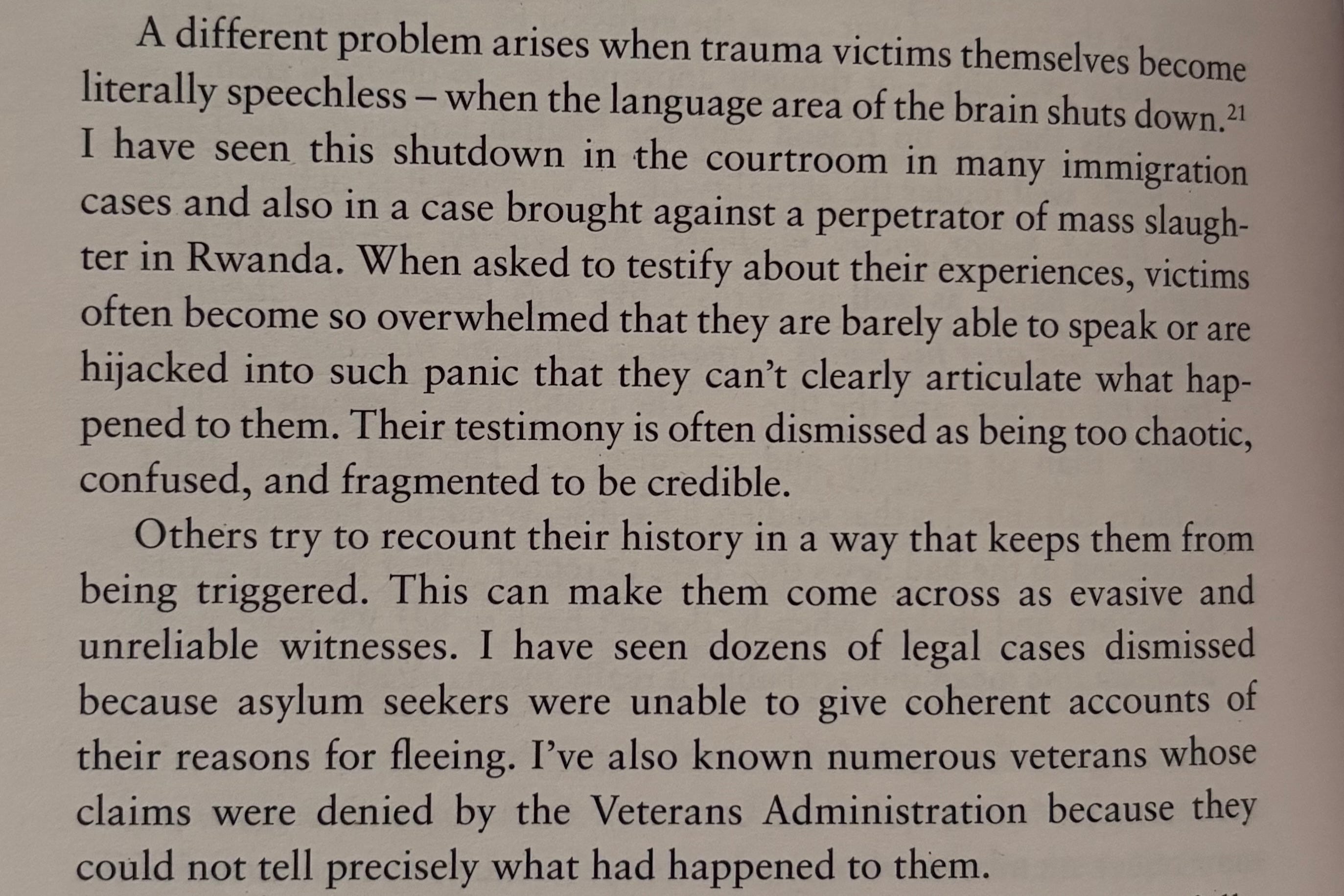
Courtrooms presume a common interpretive framework, but this falls apart when a claimant is not fluent in the language of the country, or the language of the court, or when their language breaks down under trauma. When trauma survivors experience dissociation from language, accuracy of testimony is affected. Case studies of asylum tribunals and family law provide evidence for this.
The Crown Prosecution Service explicitly recognises that dissociation, memory fragmentation, and delayed recall may appear to undermine the coherence and credibility of a victim’s account, but this does not mean that they should be dismissed as fabrication. This is common and expected in sufferers of PTSD. It points to trauma-informed practices and therapy as a way to “augment” testimony and ease of communication.
In therapy for PTSD, when processing traumatic memories, it is common to recall additional facts, sometimes quite significant ones. This is believed by many trauma experts to occur because traumatic events result in more fragmented and disorganised memories, at least for the most distressing moments of the trauma. Hence accounts often lack contextual and peripheral details which are not integrated at the time of the traumatic event.4
And yet, a study surveying over 150 legal professionals—including intermediaries, police officers, and judges—found the justice system remains broadly ill-adapted to trauma-informed practice.5 It shows a lack of awareness within legal systems of trauma and how it can impact testimony.
Case Study: LB Croydon v D
The landmark case LB Croydon v D (2024) EWFC 438 — involving allegations of non‑accidental injury inflicted by Afghan parents on their children — exemplifies these claims. Professor Jo Delahunty KC, the barrister who won the case, stressed afterwards that the courts must “never assume the reliability of records made in hospital, the police station or to social workers where translation is required.” She went further, urging that legal professionals “check dialect, check culture, check religion, check gender issues.”6
The Family Court dismissed allegations of non-accidental injury against Afghan parents, citing flawed expert evidence and credible parental accounts. Serious errors by interpreters due to cultural and linguistic miscommunication were exposed, and highlighted the requirement for sensitivity — for example the need for a female interpreter for Mrs D, a devout Afghan Muslim, due to cultural sensitivities and religious difference. Grave misinterpretations, such as translating “I don’t know” as “yesterday” were embedded in the evidence. These inaccuracies could have led to miscarriage of justice. The court’s recognition of these factors prevented wrongful separation of the children from their parents and their home.
74: Mrs D speaks and understands Afghan Dari. Farsi has frequently been the language elected by others for Mrs D despite it not being her primary language. This has resulted in misunderstanding and incorrect accounts being recorded and embedded in the evidence.
75: […] It is now clear that her answers were not transposed correctly even when dealing with the simplest of questions. By way of an example — when asked when something happened her answer of “I don’t know” was translated as “yesterday”.
This case demonstrates that linguistic sensitivity is not abstract theory but a legal necessity. Judicial humility in contexts of linguistic vulnerability can safeguard justice. We can see that although structural reforms are emerging, more action must be taken in order to ensure equitable access to justice across languages and cultures.
Sontag: Hermeneutics and Violence
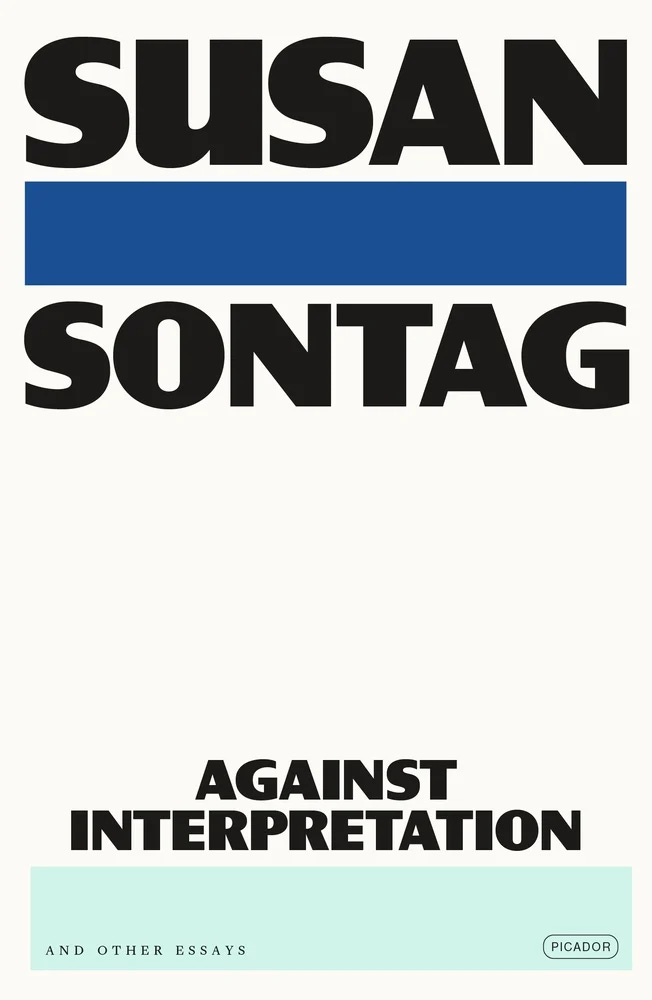
Susan Sontag, in Against Interpretation, argues that interpretation flattens and depletes experience, suppressing what is irreducible. Interpretation poisons our sensibilities; in some contexts, it is reactionary and stifling. She calls for receptivity over extraction, an erotics of art.7 We can apply her insight to legal practice. Sontag takes issue with hermeneutics (or interpretation), which dominate courtrooms. Rather than heard, testimony is parsed; victims’ words are passed through interpretive filters for possible contradictions and incoherence; cross-examination is actively hostile. In cases involving trauma, this is extremely harmful. Survivors’ fragmented accounts are pathologised as incoherent and therefore untruthful. Sontag’s alternative suggests that a courtroom might pay attention not only to the semantic content of what a survivor says — but to its rhythm, texture and silence. For example, a speaker’s pauses, tone, or non-verbal cues. It calls for a different kind of attentiveness. This approach would not dispense with existing legal reasoning, but enhance it.
Current UK Legal Practices and Reforms
Organisations such as Intermediaries for Justice and The Intermediary Cooperative, and practitioners such as Tina Pereira, a leading advocate for intermediary support, seek to address these gaps in communication. Until April 2022, no formal national scheme existed to provide access to intermediaries for suspects and defendants. Section 104 of the Coroners and Justice Act allows for intermediaries for vulnerable defendants, but Pereira notes how this has yet to be implemented. Pereira highlights how communication difficulties can prevent defendants from informed choices. Currently, there is no UK legislation allowing for special measures for vulnerable defendants, meaning that some go through criminal proceedings without a full understanding of the process or its stakes. Vulnerable witnesses benefit from the Ministry of Justice’s Witness Intermediary Scheme, but until recently defendants have lacked similar support. The introduction of Court Appointed Intermediaries is beginning to address this disparity. Courts are increasingly accommodating these needs, aiming to create a more equitable justice system.
Conclusion
When individuals must speak in a language not their own, or one from which they feel estranged, the conditions for justice shift. Their credibility is assessed through frameworks that ignore the linguistic and psychological barriers they confront. This is not justice. If the law is to serve those it governs, it must recognise the fragility of the language by which it is built. As the UK becomes increasingly linguistically pluralised, sensitive and accurate translation will only grow in importance. The law must become more epistemically modest, acknowledging that each act of legal interpretation is not neutral but an act of power. Only then can it approach the justice it purports to uphold.
Language games refer to the contextual rules and practices that give words meaning
Naomi Scheman and Peg O’Connor, Feminist Interpretations of Ludwig Wittgenstein, Pennsylvania: The Pennsylvania State University, 2002
Matthew Reynolds, Translation: A Very Short Introduction, Oxford: Oxford University Press, 2016
The Crown Prosecution Service, Pre‑Trial Therapy: Legal Guidance (London: Crown Prosecution Service, 2022, https://www.cps.gov.uk/legal‑guidance/pre‑trial‑therapy
Catherine O’Neill, People, not just books: An Investigation into the Knowledge and Understanding of Trauma Informed Practice in The Justice System, PhD diss., Canterbury Christ Church University, 2024
Public statement published by Professor Jo Delahunty KC on LinkedIn: https://www.linkedin.com/posts/professor-jo-delahunty-qc_this-was-a-case-where-but-for-robust-cross-activity-7313562573927309312-Bg82?utm_source=chatgpt.com
A sensory, empathic engagement with experience
This is good- you should check out the work of Adam Kramer KC- whilst largely about contract he similarly has read Wittgenstein in this manner.